HotLogic® HL32 Case Study
How Five Star Breaktime Solutions responded to a cafeteria closure with three HL32 placements across Alcon’s Johns Creek campus — and what Canteen operators can learn before submitting their next order.
Five Star Breaktime Solutions | Alcon Johns Creek Campus | September 2026
Early field learning for Canteen operators evaluating qualified customer placements
The Next Chapter in the Canteen HL32 Rollout
At Alcon, the operating question was not simply whether hot meals could be added. It was whether hot-meal access could be restored across three buildings and across the workday — not only at noon.
Three buildings. Three HL32s. Up to 96 meal positions. One coordinated campus opportunity.
A Foodservice Gap Across the Workday
Alcon recently closed the cafeteria serving Johns Creek Manufacturing (JCM). Employees are not permitted to leave the campus during breaks. Microwave reheating became the only established path to a hot meal, and employees do not follow one fixed lunch period — they eat throughout the day.
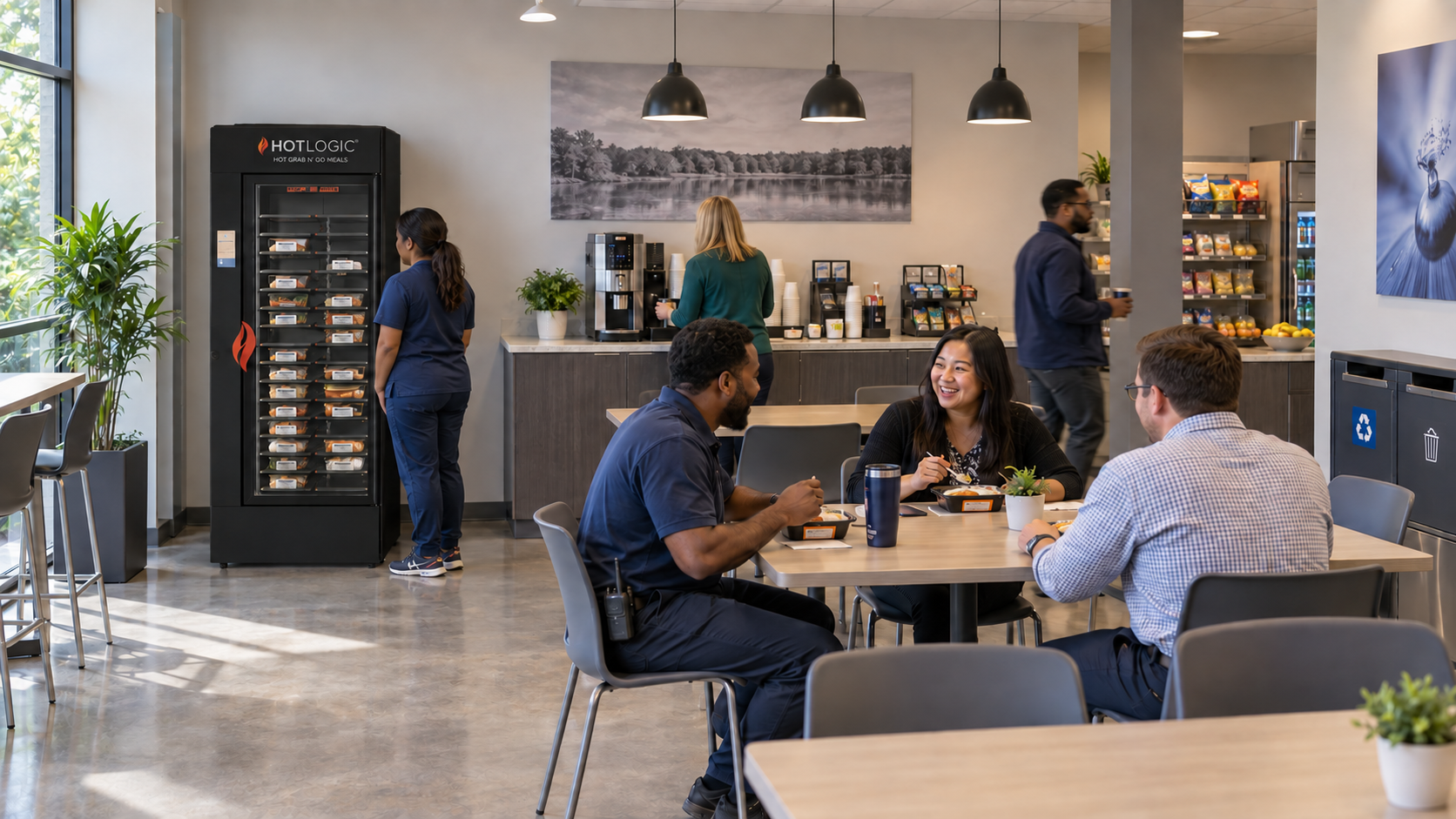
Five Star Breaktime Solutions, a Canteen operator, responded with a multi-building deployment: one HotLogic HL32 at JCM, one at Johns Creek Distribution (JCD), and one at Johns Creek Administration (JCA). With capacity for up to 32 meals per appliance, the three-unit deployment creates up to 96 meal positions across the campus.
| Catalyst | The JCM cafeteria closed, removing the site’s staffed hot-meal program. |
|---|---|
| Constraint | Employees remain on campus during breaks; off-site food is not a practical alternative. |
| Demand pattern | Eating occasions occur throughout the day rather than in one regimented lunch period. |
| Response | Five Star placed HL32 appliances at JCM, JCD and JCA as a coordinated campus program. |
The Early Signal: Demand Was Showing Up Before the Food
During a September 4 observation at JCM, the cabinet had three meals remaining at 7:32 am. At 8:20 am, eight employees finishing third shift gathered nearby, discussed the low inventory and asked when the unit would be restocked. Other employees stopped to inspect the remaining meals, but lower-shelf products were difficult to identify because meal names were not visible on the package sides.
Five Star replenished the unit at 8:57 am. The first meal positions showed ready status at 9:53 am; all positions showed ready and the door unlocked at 10:47 am. The first observed purchase occurred at 11:09 am. Ten purchases had been observed by 12:44 pm, and the field log recorded 14 JCM meals sold by 4:25 pm.
Early-Learning Evidence
The September 4 figures describe one limited JCM observation window. They are not a daily run rate, sell-through percentage, return-on-investment result or forecast for another customer. POS and inventory reconciliation should precede approved external publication.
Why the Observation Matters
The value of the JCM visit was not only the transaction count. Employees noticed the program before a conventional lunch period, returned as meals became available and made purchase decisions across several hours. The site’s first operating hypothesis is therefore clear: stock and service timing should follow validated eating occasions, not a default noon schedule.
Four Launch Disciplines Canteen Operators Can Use
- Qualify the access gap before ordering. Document when employees can eat, what hot options exist, whether they can leave the site, where traffic occurs and which demand windows a new placement is intended to serve.
- Make the offer legible before selection. Customers should be able to see the meal name, current approved price and simple purchase instructions without opening the cabinet or moving packages. At JCM, missing side labels made lower-shelf meals difficult to identify.
- Assign replenishment ownership by demand window. Five Star’s route representative described first-shift and afternoon replenishment plus designated HL32 inventory in an on-site freezer. That concept may increase resilience, but it requires approved ownership, rotation, loading, payment and food-safety procedures.
- Measure, review and adjust. Track each building separately. Use aggregate sales, units loaded, stockout minutes, waste, availability, service issues and feedback to refine assortment, route cadence, signage and service timing before making performance claims.
What Alcon Adds to the Rollout Playbook
Alcon advances the program from a single placement to a coordinated campus model. JCM, JCD and JCA share common equipment and operating standards, but each building may have different traffic, meal preferences and demand windows. The operator’s task is to standardize what should be common — training, labeling, measurement and accountability — while optimizing what must remain local.
| Standardize across the program | Optimize by customer and building |
|---|---|
| Operator training and approved load sequence | Placement and traffic pattern |
| Visible meal identification and approved pricing | Demand windows and replenishment timing |
| Food-safety, cleaning and exception procedures | Menu mix, par levels and buffer stock |
| POS/inventory reconciliation and KPI definitions | Service hours and communication |
The Operating Standard
Design the launch to minimize stockouts during validated demand windows, then measure availability, sales and waste and adjust the plan.
The Evidence to Collect Next
- Building-level sales, loads, carryover, waste and availability by approved time band.
- Stockout and low-stock minutes, meal-level assortment performance and aggregate feedback.
Could One of Your Customers Be the Next Qualified HL32 Site?
The Alcon lesson is not that every multi-shift site should order an appliance. It is that the right operator can identify a documented access gap, build an executable service plan and submit an order that is ready to launch, not merely ready to ship.
A qualified opportunity is ready when…
- ✓ Customer sponsorship. The customer approves the business question, site name, placement review and operating stakeholders.
- ✓ Documented access rationale. The operator has identified actual eating occasions, current alternatives, traffic and the gap the HL32 is intended to address.
- ✓ Placement and power approval. The proposed location, dedicated electrical requirement, delivery route, clearances, egress and access have been reviewed.
- ✓ Named operating owner. Route service, replenishment, buffer inventory if any, cleaning, exceptions and escalation have accountable owners.
- ✓ Menu and merchandising readiness. Meal source, assortment, price, packaging, side label, signage and payment workflow are approved.
- ✓ Food-safety and cleaning confirmation. The responsible parties have approved handling, temperature, labeling, cleaning, discard and corrective-action procedures.
- ✓ Measurement and review plan. The go-live date, starting inventory, reporting period, POS/inventory reconciliation owner, aggregate KPIs and review date are defined.
- ✓ Order authority. Customer placement approval and operator purchase authority are complete.
Early field experience may not represent typical results. Site performance depends on customer conditions, placement, menu, pricing, replenishment, operation and measurement.