Prepared for: Canteen, Compass Group, Medtronic, and HOTLOGIC® Stakeholders
Prepared by: Bernie Youngblood, HOTLOGIC®
Site visited: Medtronic Memphis Airport Logistics Center, 5300 Airways Blvd, Memphis, TN 38116
Dates of visit: Tuesday–Wednesday, August 11–12, 2026
Executive Summary
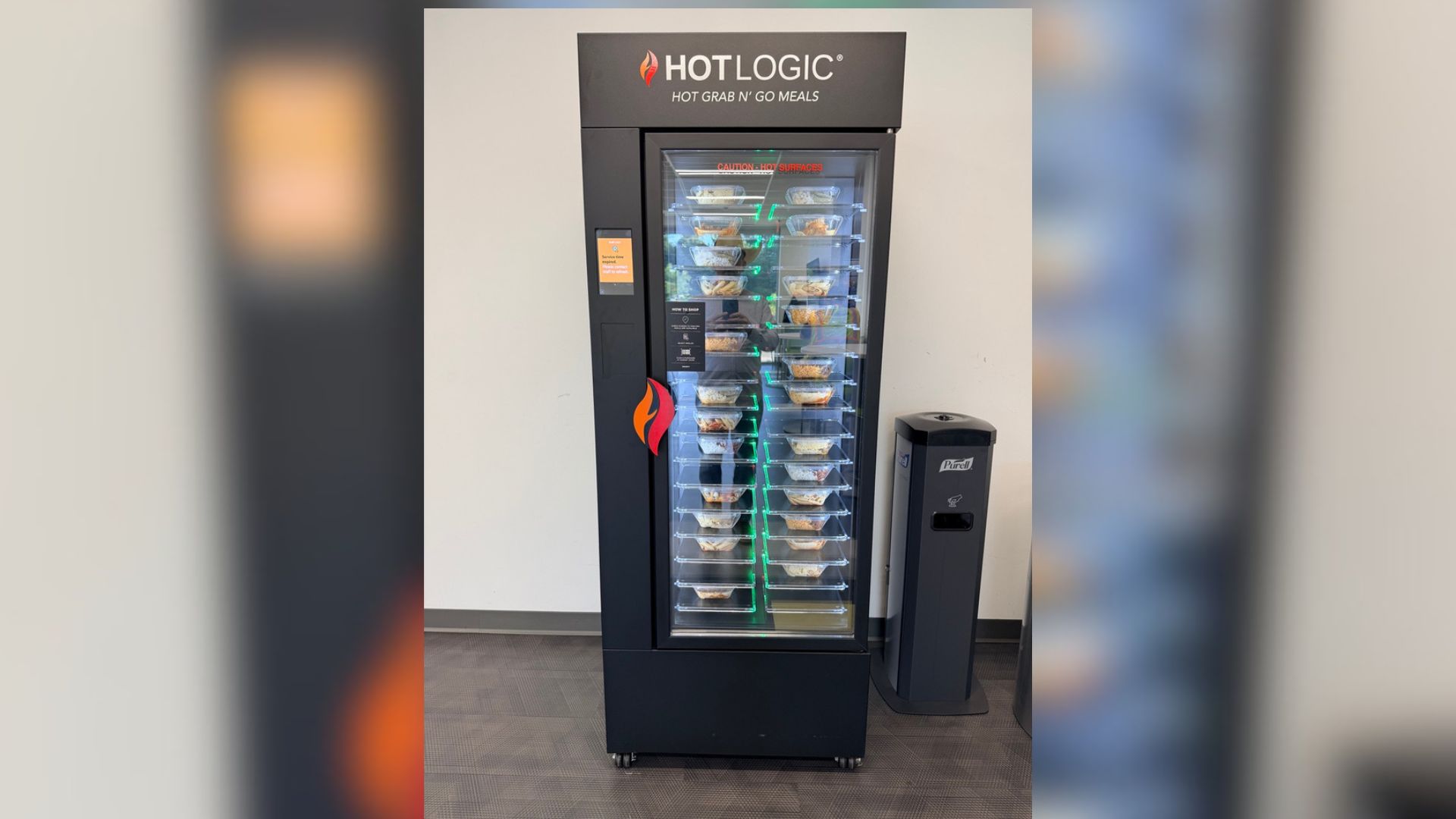
Following the successful HOTLOGIC® HL32 SmartShelf™ pilot at Cardinal Glass in Church Hill, Tennessee, Canteen selected Medtronic’s Memphis Airport Logistics Center as one of the first sites in its broader HL32 deployment program – part of a 250-unit rollout across Canteen client locations nationwide.
The 1.1-million-square-foot logistics facility is exactly the kind of environment the HL32 was built for: a large workforce spread across multiple shifts, minimal nearby restaurant options, and no staffed onsite foodservice. A HOTLOGIC® representative visited on August 11–12, 2026 to observe not just the unit’s operation, but how employees discovered, understood, and reacted to an entirely new kind of hot-meal access – and to meet with the Canteen team member responsible for running it day to day.
The HL32 is not simply adding another vending option at Medtronic – it is introducing a new foodservice behavior where none existed before.
Day One showed real employee curiosity and a strong 2nd-shift purchasing rush, alongside a short list of fixable merchandising gaps. Day Two told a different, equally important story: the unit sat unstocked all morning, and employees kept showing up to check on it anyway – clear evidence that awareness and expectation are already building, even when there’s nothing to sell. That same day, a conversation with Canteen’s onsite market manager surfaced both a supply-cadence gap to fix and a genuinely promising partnership already taking shape.
The Site: A Strong Fit for Unattended Hot Meals
The Medtronic Memphis Airport Logistics Center sits on 5300 Airways Boulevard, an approximately 1.1-million-square-foot manufacturing and logistics facility (shared tenancy with CEVA Logistics) with an estimated 600 team members working across 1st and 2nd shift.
The facility has no staffed onsite foodservice. Employees have historically relied on the Avenue C market – cold sandwiches, microwaveable meals, snacks, and beverages – or brought food from home. Offsite alternatives are limited; the facility sits in a food desert. Avenue C seats roughly 90 people, while two additional break rooms elsewhere in the facility offer refrigerators, microwaves, and traditional vending, but no HOTLOGIC® equipment yet.
Can unattended hot-meal service create an entirely new food occasion at a large facility where employees have traditionally accepted cold food, microwaved meals, or food brought from home?
What HOTLOGIC® Observed
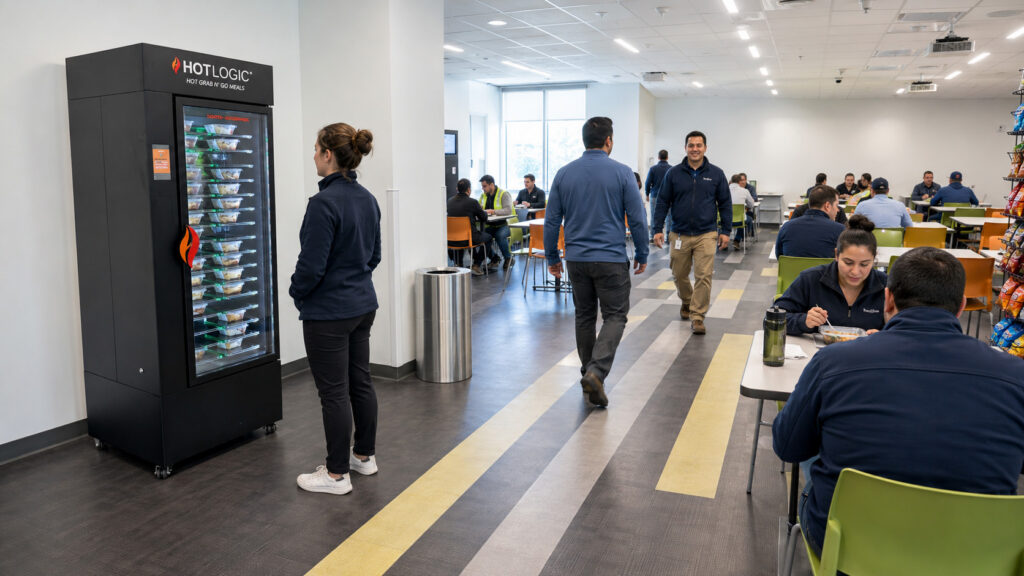
The representative arrived at approximately 12:20 p.m. to find the HL32 fully stocked with 32 meals, positioned prominently along the main walking aisle adjacent to Avenue C.
Employee curiosity was immediate and sustained. Across the 1st-shift lunch window, more than a dozen individuals and pairs stopped to open the unit, examine meals, and discuss selections – continuing even after the traditional lunch period ended. Most, however, had already eaten and did not purchase.
The visit drew an important line between interest and conversion. Employees were clearly drawn to the food, but several first-time users didn’t immediately understand what the meals were, what they cost, how to pay, or – in at least one case – that the meal would already be hot. These aren’t technology problems; they’re merchandising and customer-education opportunities, and relatively easy ones to solve.
Second Shift Reveals the Opportunity
The strongest activity of the day came as 2nd shift arrived. At approximately 4:37 p.m., at least eight employees approached the HL32 in a concentrated rush, with four selecting and purchasing meals on the spot.
One employee was visibly surprised to find her meal already hot when she removed it – a small but telling sign of just how unfamiliar unattended hot-meal service still is to first-time customers. Two other employees specifically searched for a meatloaf meal they’d apparently had before; when it wasn’t available, they chose not to substitute.
Employees were already remembering – and returning for – specific HL32 meals.
Avenue C’s occupancy underscores the shift: the space typically averages about 35 occupants during the 1st-shift lunch hour, but reached roughly 38 during the observed 2nd-shift rush – a workforce that, until now, had no hot-meal option built around its schedule at all.
By the time the HL32’s service window closed at 5:20 p.m. – while 2nd shift was still active – confirmed purchases across the day totaled eight meals: two during the early afternoon and four in the 2nd-shift rush (plus two purchased by the HOTLOGIC® representative to sample the product). Modest by later-pilot standards, but notable given a single partial-day visit with zero promotion, no visible pricing, and service hours that cut off before the shift did.
The Food Experience Works
HOTLOGIC®’s representative independently purchased and sampled two meals during the visit:
- Salsa Verde Chicken with Rice & Beans – $5.59 – rated 8/10, “tasty and filling”
- Thai Chili Chicken & Rice – $5.59 – rated 7/10, “hot and delicious”
Sustainable adoption depends on more than the equipment – selection, convenience, temperature, quality, and value all have to work together for the customer. Early evidence at Medtronic suggests that equation is already in place.
What We Learned: Visibility Is Not the Same as Understanding
The HL32 was highly visible and well positioned – but several elements needed to turn curiosity into purchases were missing or unclear:
- Meal descriptions were not readily visible from the front of the unit
- Pricing was not displayed on individual meals
- Some employees didn’t understand the purchase process
- Some employees didn’t realize the meals were already hot and ready to eat
- Employees with limited English proficiency had difficulty reading the existing signage
- The program had received limited onsite promotion or advance notice
- Service availability ended at 5:20 p.m., despite an active, hungry 2nd-shift workforce
Installing the HL32 creates availability. Merchandising and communication create adoption.
Strong Early Support from the Site
Perhaps the most encouraging feedback came from Medtronic operations itself. The site’s operations manager reported that meals had sold well during the initial introduction period, describing stretches where “The HL32 was getting cleared out.”
Day Two: When the Machine Sits Empty
The representative returned the next morning, August 12, and found the HL32 had not yet been restocked. Over the next two hours, three separate individuals or pairs stopped at the unit – lingering, tapping the screen, inspecting the empty shelves – only to find nothing available for sale.
Even with nothing to sell, people kept showing up to check. That’s not a failure – it’s a demand signal.
By noon, Avenue C had reached 48 occupants – the highest single count recorded across both days – and several employees specifically asked about the HL32’s status. A day earlier, that same curiosity converted into eight purchases. On Day Two, an empty machine converted it into nothing. The gap between those two outcomes is entirely about supply reliability, not product appeal.
A Working Session with Canteen’s Onsite Team
At 11:36 a.m., Canteen’s market manager for the site stopped by. He explained that the unit’s next meal shipment wasn’t scheduled to arrive until Sunday – a cadence clearly mismatched to a site where demand (as Day One showed) concentrates around 1st-shift lunch and 2nd-shift changeover, day in and day out.
The conversation was substantive and productive:
- The manager agreed the labeling and pricing gaps identified on Day One were real problems, though not ones within his direct control; he committed to escalating them, and HOTLOGIC® did the same.
- The two discussed how to support a multi-shift site within Canteen’s 3-hour hot-hold standard – the manager grasped the tradeoffs quickly and engaged seriously with the operational question.
- The manager shared an 8½” x 11” laminated menu template his team had already prepared, with pricing included – a proactive step ahead of any prompting.
The representative suggested posting that menu alongside a Spanish-language version directly on the unit, referencing the non-English-speaking employees observed on Day One, and left the manager with direct contact information and an open invitation to call with any questions.
At this pricing, the machine should be selling out every day, on every shift.
The managers engagement – the menu template already in hand, the willingness to problem-solve the hot-hold standard, the quick agreement on next steps – is itself a meaningful early indicator: the person responsible for running the HL32 day-to-day is already thinking like an owner, not just an operator.
The Real Opportunity: Becoming a Trusted Daily Option
Two days on site point to a challenge that’s less about the equipment and more about habit formation. The large majority of Medtronic’s team members currently bring lunch from home – a decision made fresh every day, precisely because there’s no reliable local alternative to plan around.
That’s the real opportunity, and the real risk. If the HL32 can’t be counted on – stocked, labeled, priced, and available whenever a shift needs it – team members will keep treating it as a backup option, used only when they forget a lunch or run short on time. But if it becomes dependable, the calculation changes: employees can start proactively planning their breaktime meal around what the HL32 offers that day, rather than around what they packed the night before.
That difference – casual backup versus daily habit – could be the difference between one purchase a month and four to eight, a 400% to 800% swing in volume per team member.
This is the clearest way to frame the Medtronic opportunity for any Canteen operator evaluating an HL32 deployment: the upside isn’t capped by how many people try the machine once. It’s set by how many people come to depend on it – and that depends entirely on consistent stocking, clear pricing, and reliable availability across every shift.
Opportunity Beyond the Main Dining Area
A tour of the facility identified two additional break rooms of approximately 1,200 square feet each, both currently containing community refrigerators, microwaves, and vending machines – but no HOTLOGIC® units.
In a facility this size, walking distance itself becomes a foodservice barrier. Additional HL32 placements could bring hot meals closer to employees rather than requiring them to travel across the facility during short break periods – echoing a lesson from Cardinal Glass, where physical plant size shaped the case for multiple units per site.
From Cardinal Glass to Medtronic: Building a Repeatable Model
Cardinal Glass demonstrated that the HL32 could reliably deliver hot meals across shifts while achieving strong early sales and staff acceptance in an active, monitored pilot. Medtronic adds a distinct and equally important lesson:
The technology can be ready before the customer behavior is.
At a site with existing foodservice infrastructure, the HL32 extends a known program. At a site like Medtronic – with no staffed foodservice at all – the HL32 has to create an entirely new hot-meal occasion from scratch. That takes a deliberate launch sequence, not just equipment placement:
Placement → Awareness → Education → Merchandising → Trial → Repeat Purchase
| Cardinal Glass | Medtronic Memphis | |
| Facility type | Manufacturing plant | Manufacturing + logistics/warehouse |
| Onsite population | ~750 | ~600 |
| Existing foodservice | Commissary (“The Bird Feeder”) | None (self-serve micro-market only) |
| 2nd-shift hot-meal access (prior) | None | None |
| Days observed | Days 1–3 | Days 1–2 (two site visits) |
| Operator reaction | Enthusiastic | Enthusiastic – proactively requested expansion; strong onsite Canteen engagement |
Note: Sales volume is not directly comparable between sites – Cardinal Glass figures reflect Day 3 of an actively monitored pilot with engaged kitchen staff; the Medtronic figures reflect a single Day 1 visit with no dedicated promotion, imperfect labeling, and no visible pricing.
Five Early Lessons for Future Canteen HL32 Deployments
1. Introduce the concept – not just the machine.
Many customers have never encountered unattended, ready-to-eat hot meals. Simple messaging such as “Hot Now – Just Select, Pay & Enjoy” can remove uncertainty.
2. Make meals and prices visible.
Customers should be able to see what’s available and what it costs before opening the unit.
3. Merchandise around actual demand.
Employees asking specifically for a previously offered meatloaf shows the value of tracking favorites and keeping popular selections in rotation.
4. Pay special attention to underserved shifts.
2nd shift produced the day’s most concentrated interaction – and may represent one of the strongest opportunities for incremental sales, since it’s the shift traditional foodservice most often overlooks.
5. Give adoption time – and give it enough hours to work.
At sites where employees have spent years bringing food from home, the goal isn’t replacing an existing purchase – it’s building a new habit. Awareness, trial, and repeat purchasing build over time, and service hours need to match when demand actually shows up (2nd shift, in this case), not just when 1st shift does.
6. Match the restock cadence to the site, not the default schedule.
A default weekly shipment cycle can leave a high-traffic, multi-shift site sitting empty for days at exactly the moment trust is being built or lost. Confirm restocking frequency against actual shift-by-shift demand before launch, not after the first stockout.
Early Indicators of Opportunity
- A fully stocked, well-placed, and operational HL32 on Day One
- Strong, sustained employee curiosity across both visits – including a full morning with nothing to sell
- Concentrated 2nd-shift engagement outpacing 1st shift
- Evidence of repeat interest in specific meals (the “meatloaf” moment)
- Positive meal quality and value, confirmed firsthand
- Site operations reporting strong sell-through during the initial introduction period
- A short, addressable list of merchandising and communication gaps, including a laminated pricing menu Canteen’s team had already prepared
- Two additional break rooms that could support future multi-unit deployment
- Unprompted site-level interest in replacing an existing hot-food machine with more HL32 units
- An engaged, solutions-oriented Canteen market manager already thinking about multi-shift coverage and hot-hold logistics
What Needs to Happen Next
- Align the restock schedule to the site’s actual shift-by-shift demand – not a default weekly cycle
- Finalize and post the laminated pricing menu, in English and Spanish, directly on the unit
- Escalate the front-of-package labeling and pricing gap to whoever controls meal packaging, since it sits outside the site team’s control
- Formalize a shared approach to the 3-hour hot-hold standard across a 24-hour, multi-shift operation
- Extend service hours (or restocking timing) to cover an active 2nd shift, not just 1st-shift lunch
Conclusion
Medtronic Memphis illustrates something important for the expanding Canteen HL32 program: success isn’t just measured by what happens after a machine is installed – it’s measured by how quickly a team learns what each location needs to make it stick.
At Medtronic, the need is clear: roughly 600 employees working across shifts in a massive logistics facility, with no staffed foodservice and few convenient alternatives nearby. Two days on site produced two different but complementary pictures – Day One’s curiosity and purchases, and Day Two’s reminder that reliability, not just appeal, is what turns a novelty into a habit. Both days, though, pointed to the same conclusion: the demand is real, the onsite Canteen team is engaged and capable, and the remaining gaps are operational, not fundamental.
The HL32 provides the infrastructure. The next step is turning availability into habit – and that starts with never leaving the shelf empty.